London College of Communication (UAL), RMIT University Melbourne, RMIT University Vietnam, and Elisava, Barcelona. Exhibited at Melbourne Design Week and Barcelona Design Week.
The Common Design Studio is an international collaborative teaching and research project co-developed by staff from London College of Communication (UAL), RMIT University Melbourne, RMIT University Vietnam, and Elisava, Barcelona. I worked as a core contributor to the development and delivery of the studio, shaping its pedagogical approach, project themes, and international collaborations in partnership with teaching colleagues across the four institutions.
The studio brought together students, educators, industry partners, and researchers through intensive design sprints that addressed complex global and ecological challenges. Its structure emphasised participatory research, systems thinking, and practice-based experimentation, enabling transnational student teams to work across cultural, disciplinary, and geographic boundaries. Across multiple iterations, projects explored themes including sustainability, urban ecologies, microplastics, recycling, playable cities, and collective action.
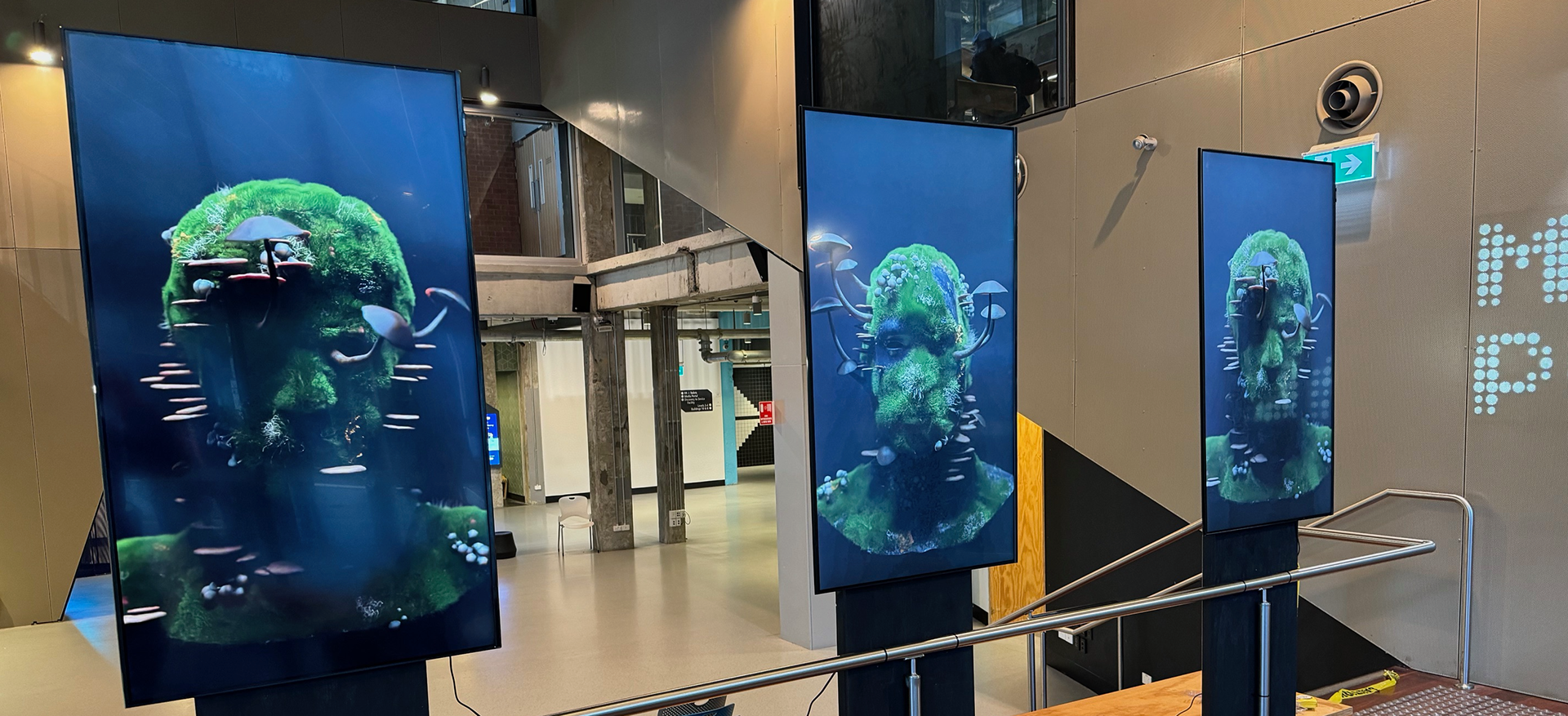
Installation at the Melbourne Design Week
MYCOCOSM, Melbourne and Barcelona Design Weeks
In 2024, the Common Design Studio expanded into a staff and alumni exhibition titled MYCOCOSM, presented at Melbourne Design Week and later at Barcelona Design Week. The exhibition investigated mycelium as both a biological system and a conceptual model for design practice, focusing on processes of branching, fusion, interdependence, and networked knowledge.
I developed and exhibited Memento Vivere (Remember to Live) as a collaborative visual project with first year BA User Experience Design student Riley Heasley. The work was conceived as a staff–student collaboration that extended the teaching ethos of the Common Design Studio into shared practice-based research. Using generative image-making, 3D modelling, and moving image, the installation explored mycelial growth, decay, and non-human temporalities, with moss and fungal forms slowly overtaking sculptural busts across a looping video triptych.
The exhibition positioned practice as a pedagogical artefact, feeding directly back into the Common Design Studio teaching framework and providing future cohorts with a live example of collaborative, research-led design practice. It reinforced the studio’s commitment to international exchange, shared authorship, and design as a method for thinking critically about ecological futures.